Showing posts with label Historical Churches. Show all posts

Thursday, 27 December 2012

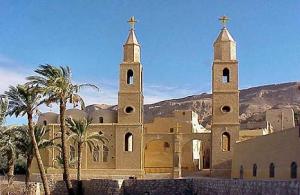
Historical Churches - St. Antony's Monastery (Deir Mar Antonios)at foot of Al-Qalzam Mountain near Al Zaafarana, Egypt

St.  Antony
The Coptic Monastery of Saint Anthony in Egypt
St Antony,  son of well-to-do parents, he was orphaned at the age of 18 and upon hearing the Words of the Gospel, he gave all his possessions to the poor and placed his younger sister in a house for virgins, and sought to live a solitary life with God. His fame spread not only throughout Egypt and throughout the Roman Empire, many scholars, philosophers and emperors, including Emperor Constantine and his sons. St Antony died at the age of 105 on Mount Colzim; the site of the present day Monastery of St Antony the Great, a community was formed shortly after the saint’s death in memory of him. St Antony feast day is celebrated in the Coptic Church on 30 January, which corresponds to 22 Tuba according to the Coptic calendar. His life defined the nature of monastic spirituality and became the model for all subsequent forms of ascetic life. St. Antony's Cave (magharah), where he lived as a solitary person, is a 2 km hike from the monastery and 680 m. above the Red Sea. It offers stunning views of the mountains and the sea.
St. Antony's Monastery
The Coptic Monastery of Saint Anthony in Egypt
St. Antony's Monastery (Deir Mar Antonios), and its neighbor St. Paul's, are both Coptic Christian and are the oldest inhabited monasteries in Egypt. Hidden deep in the Red Sea Mountains and relying on springs for their water supply, both still observe rituals that have hardly changed in 16 centuries. St. Antony's Monastery, which lies at the foot of Al-Qalzam Mountain near Al Zaafarana, was founded in 356 AD just after the saint’s death and is the oldest active monastery in the world. St. Antony founded several monasteries during his life but they do not exist anymore. During the sixth and seventh centuries, many monks from Wadi Natroun were under frequent attacks by Bedouins and they migrated to St. Antony's.  This monastery was plundered on many occasions and was also partly destroyed in the 11th century. Between the 12th and 15th centuries, the monastery flourished but was plundered again in 1454 by Bedouin servants. Due to such attacks, this is a fortress style monastery. Though Coptic today, over its many years the monastery was often multi-faith, housing monks of several different Christian Denominations. The Monastery has exceptional wall paintings of holy knights in bright colors and the hermit founders of the monastery in subdued colors and icons. These wall paintings, widely know to monks and art historians, were obscured by soot, candle grease, oil and dust, but recently, in a collaborated effort between the Supreme Council of Antiquities and the American Research Center in Egypt, these unique painting were restored.
  • Egypt's Coptic church chooses new pope in ceremony (foxnews.com)
  • Egypt's Copts to vote for Pope (bbc.co.uk)

Historical Churches - Kisha Shën Mëri Vllaherna (Church of Saint Mary of Vllaherna),Berat, Albania

Kisha Shën Mëri Vllaherna (Church of Saint Mary of Vllaherna)
The city of Berat is called the town of a thousand windows, and it is one of the oldest towns in Albania, thought to have been founded in the 6th century BC. Kisha Shën Mëri Vllaherna (Church of Saint Mary of Vllaherna), is situated in the city of Berat near Saint Nicolas and Saint Costandin and Helena. It is preserved and in good condition.  This building is St. Mary's Orthodox Church, perched high on the side of a hill and inside the third century fortress of Berat.  St. Mary's Orthodox Church was built in the 13th century AD. It is built in a different style and uses stones mixed with bricks.  It has 16th Century frescoes painted by Son of Onufri.

Historical Churches - The Church of the Assumption of the Virgin Mary, Bled Island, Slovenia

The Legend
The Church of the Assumption of the Virgin Mary, Bled Island, Slovenia
According the Legend has it that on this place once stood a shrine of the Ancient Slavonic goddess Živa and was burnt down during the Christian war against the pagans. Priest Staroslav and his daughter Bogomila guarded it when Črtomir came to the island. The temple was destroyed during battles between the followers of the Pagan Cult and Christians, who destroyed the altar and built a church. Bogomila stayed in the new church with her father, while Črtomir, after his baptism near the Savica waterfall, went to Aquilea and became a missionary of the Aquilean patriarch among Slovenes.  The bell has its own tale as well. It sank to the bottom of the lake during its transport to the island. Later on, the Pope sent a new bell for the church. To commemorate this event, the locals annually organize a symbolic pulling-the-bell-out -of-the -water. Visitors can chime the Wish Bell in order for their wishes to come true. On the Bled Island, archeologists have discovered traces of prehistoric (11th to 8th centuries B.C.) and Slavic (9th to 10th century) settlements. 124 graves with skeletons from the 9th to the 11th century were found.
The Church
Lake Bled Island Church Altar
The Church of the Assumption of the Virgin Mary, Bled Island, Slovenia located on the island surrounded by the lake, presents the most recognizable icon at Bled Island. The first masonry church on the island, a three-naved Romanesque basilica, was consecrated by the Aquilean patriarch Pellegrino in 1142. In the 15th century, it was rebuilt in the Gothic style: a new presbytery, a freestanding bell tower and the main altar were built. The renovated single-nave church was consecrated in 1465 by the first Bishop of Ljubljana, Count Žiga Lamberg. In 1509 it was so damaged by an earthquake that it required thorough renovation, and this was carried out in the Baroque style. Only the frescoes in the presbytery and a wooden statue of the Virgin Mary, which probably adorned the main altar, are preserved from the previous Gothic Church. The church's present form is from the 17th century when it was renovated after another earthquake. The bell tower, which was built in the 15th century, has been renovated several times due to damage by two earthquakes, and in 1688 it was struck by lightning. The present tower is 54 m high and has three bells.
  • Virgin Mary image found in piece of wood (fox13now.com)
  • VIRGIN MARY: Malaysian church gets hospital window that drew crowds believing they saw Virgin Mary image (vancouverdesi.com)

Wednesday, 26 December 2012

Historical Churches - Santhome Cathedral at Mylapore,Chennai, India

St. Thomas Basilica is built over the tomb of Apostle St. Thomas.  St. Thomas one of the twelve Apostles of Jesus Christ came to India in A.D.52, martyred in A.D.72 and was buried here in  Mylapore.
Santhome Cathedral,  Mylapore,Chennai, India
There are only three basilicas built over the tomb of an apostle. St. Peter's at Rome and St. Jame's at Spain (Compestella, Santiago) are the other two. There is an underground tomb chapel below the Basilica of St. Thomas who brought Christianity to India is considered to be the Father of Indian Christianity’ here pilgrims can pray in front of the Sepulcher of St. Thomas. People believe that sand taken from the tomb has Miraculous Healing Powers. The church has made a Beautiful Credit Card for pilgrims, the St. Thomas Card, with a little of the St. Thomas sand embedded in it. This can be carried around like a normal credit card in a wallet or purse. Renovated in the early 1970s, this Basilica draws huge crowds. There is a beautiful stained glass window at The Basilica, which portrays the story of St. Thomas and the central hall has 14 wooden plaques depicting scenes from the last days of Christ. In The Cathedral is a 3ft. high statue of Virgin Mary, which was brought from Portugal in 1543. The official residence of the Archbishop of the Madras, Mylapore Archdiocese is in Santhome adjacent to The Basilica.

Historical Churches - The Sanctuary of Our Lady of Fátima in Fátima, Portugal

The Legend.
The small town of Fatima, 88 miles (140km) North of Lisbon, is one of the world’s most important holy sites.
The Sanctuary of Our Lady of Fátima in Fátima, Portugal
In 1917 the Virgin Mary appeared here to Three Shepherd Children and in 1930. Between May and October 1917, Our Lady appeared six times to three young Portuguese children in a field called the Cova de Iria, near the small village of Fatima, about seventy miles north of Lisbon. The children who received the apparitions had been brought up in an atmosphere of piety. They were Lucia dos Santos, aged ten, and her two younger cousins Francisco and Jacinta. They tended sheep together and often would kneel in the open field to pray the Rosary.On the day of the final apparition, October 13, 1917, she identified herself as "Our Lady of the Rosary" and the dramatic episode of the dance of the sun took place, witnessed by a crowd of seventy-thousand people, in which the sun seemed to tumble from the sky. The Catholic Church officially recognized these visions and The Basilica of Our Lady of the Rosary was built.
The Church
The first structure of The Sanctuary of Our Lady of Fátima in Fátima, Portugal was built on the location of the apparitions was a small archway which was soon replaced by a tiny chapel over the spot of the apparitions.
The Sanctuary of Our Lady of Fátima in Fátima
First chapel was destroyed by dynamite in 1922, a second chapel was built. The foundation stone for The Basilica of Our Lady of the Rosary was laid on October 13, 1928 and the finished structure was solemnly consecrated on October 6, 1953. This Neoclassical Church can hold 300,000 persons inside.  Those who are dressed properly are permitted entrance. Two of the three children who first saw the vision are buried here.

Historical Churches - Church of St. Gregory the Great at Kercem, Malta

Church of St. Gregory the Great at Kercem
The village of Kercem lies close by to the south-east of Victoria; this village has the most beautiful landscapes in the Island of Gozo. Archaeological Discoveries show that the sizeable area of Kercem was inhabited as early as the Ghar Dalam Phase (5000-4500 BC). The Roman Baths and an early Christian cemetery at Ghar Gerduf, referred to by Gozitan historian De Soldanis as Roman Catacombs, are also significant discoveries. Kercem evolved into a village community in the late Middle Ages, around an ancient chapel dedicated to Pope St. Gregory the Great built around 1581. The site gained historical importance due to the annual Traditional St. Gregory Procession from the Matrix Church in Rabat (Victoria) to this Medieval Chapel, upon the saint's feast, namely on the 12th of March. The chapel was however replaced by the present parish church in 1851 which in turn was expanded later on to its present state in between 1906-1910.  It foundation stone was laid at the end of the procession on the Feast of Saint Gregory on 12 march 1846. It was consecrated on 22 October 1912. The village was established a parish church on 10 March 1885. The Village Church was traditionally dedicated to Pope St. Gregory, but since 17th August 1885, the church was additionally co-dedicated to Our Lady of Perpetual Help.

Tuesday, 25 December 2012

Historical Churches - The Christ Church, Rawalpindi, Pakistan.


The Christ Church, Rawalpindi is located in Rawalpindi, Pakistan. It was built in 1852 in the Gothic Style. The Church is situated in Lal Kurti in cantonment area on Iftikhar Janjua Road beside PC Hotel in Rawalpindi. The church is considered among the oldest buildings in Rawalpindi. The Church is affiliated with the Church of Pakistan and serves mass largely constitutes of Army and Civilian persons living in and around Cantonment area.