Showing posts with label USA. Show all posts

Monday, 31 December 2012

Beautiful Churches - The Salt Lake Temple(Latter-day Saints) at Salt Lake City, Utah, USA

Wonderful granite structure of The Salt Lake LDS Temple was constructed over a period of 40 years, from the laying of the cornerstones on 6 April 1853 to the dedication on 6 April 1893.
The Salt Lake Temple, Utah, USA
The location for the temple was first marked by Brigham Young, the priest and second president of the church, on July 28, 1847, just four days after arriving in the Salt Lake Valley. The temple site was dedicated on February 14, 1853. Groundbreaking ceremonies were presided over by Brigham Young, who laid the cornerstone on April 6 of that year. The Salt Lake LDS Temple is the centerpiece of the 10-acre (4.0 ha) Temple Square in Salt Lake City, Utah. The Salt Lake Temple took 40 years to build with its highly ornate interior being completed in just a year. The walls of the Salt Lake Temple are nine feet thick at the base and six feet thick at the top. The Salt Lake Temple features beautiful hand-painted murals on the walls of its progressive-style ordinance rooms: Creation Room, Garden Room, World Room, Terrestrial Room (no murals), and Celestial Room (no murals). Rich symbolism adorns the exterior of The Salt Lake LDS Temple, depicting mankind's journey from mortality into the eternal realms.
SLC Temple Assembly Hall
  • The Angel Moroni depicts both a messenger of the restoration of the gospel and a herald of the Second Coming: "for the Son of Man shall come, and he shall send his angels before him with the great sound of a trumpet, and they shall gather together the remainder of his elect from the four winds"( Revelation 14:6).
  • The three towers on the east side represent the First Presidency of the Church and the Melchizedek Priesthood; the twelve pinnacles rising from the towers represent the Twelve Apostles. The three towers on the west side represent the Presiding Bishopric and the Aaronic Priesthood; the twelve pinnacles rising from the towers represent the High Council.

  • The castle-like battlements that surround the temple symbolize a separation from the world as well as a protection of the holy ordinances practiced within its walls.
  • The Earthstones, located at the base of each buttress, represent the earth—the "footstool of God."
  • The moon is depicted in its various phases around the temple. The changing moon can represent the stages of human progression from birth to resurrection.
  • The sunstones depict the sun—a symbol of the glory of the celestial kingdom.
  • High above the sunstones on the east center tower are two clouds with descending rays of light. Once temples were dedicated in ancient Israel, they were filled with the "cloud of the Lord."
  • Six-pointed stars represent the actual stars in the heaven. Upside-down five-pointed stars represent morning stars, compared to the "sons of God" in the scriptures. The large upright five-pointed stars may represent the governing power of the priesthood while the small upright five-pointed stars may represent the saving power of the priesthood for those who attach themselves to it.
  • Located atop each of the center towers of the temple is the all-seeing eye of God, which represents God's ability to see all things.


  • 1870s LDS baptistry discovered on site of Provo City Center Temple (fox13now.com)

Sunday, 30 December 2012

Beautiful Churches - The Crystal Cathedral, Garden Grove, Orange County , USA

      The Crystal Cathedral was a pure show biz, from its movie star guest speakers to its artful use of the power of TV. The largest glass building in the world, The Cathedral was built by the Rev. Robert Schuller.
The Crystal Cathedral, Garden Grove, Orange County , USA
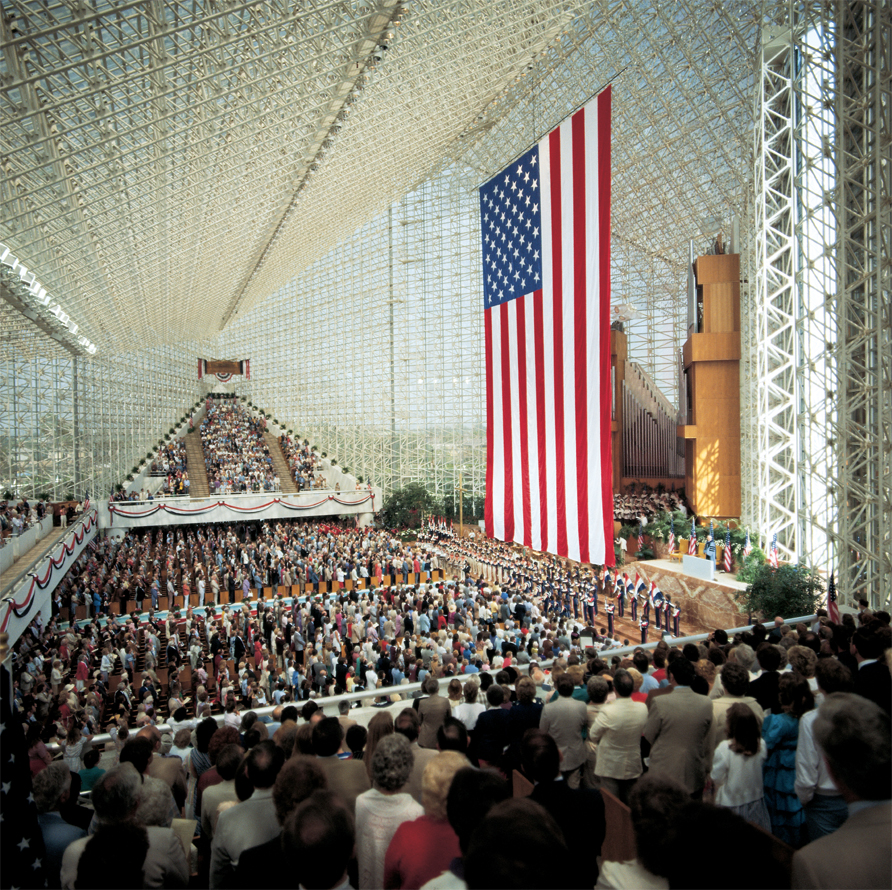
The building, designed by architect Philip Johnson, was completed in 1981 and seats 2,736 people. Schuller started out in 1955, as pastor of California's first "drive-in" church, in Garden Grove. It was actually situated in an old drive-in movie theatre, Schuller preached from the roof of the concession stand. After significant success on the airwaves, Rev. Schuller opened the Crystal Cathedral in 1980. Each week, the Sunday services at The Crystal Cathedral were broadcast live across the nation as "The Hour of Power," and they often featured Hollywood stars.  The Crystal Cathedral’s pipe organ with 16,000 pipes is among the five largest pipe organs in the world, the Hour of Power Choir with 100-plus voices is also an interesting feature and the electric fountain/stream that runs down the middle of the central aisle is also worth mentioning. The mammoth church is indeed impressive, made almost entirely of glass and a spider web framework of white steel, the star-shaped "cathedral" is something extra ordinary. Over 400 feet long and 200 feet across, raising some 12 stories above the ground, with an angular, mirror-like exterior, its transparent, sun-lit interior features a giant television screen, and an altar of rich marble.  The Crystal Cathedral can accommodate about 3,000 worshipers for Sunday services. Giant, sliding glass doors on the side of the church allow even more worshipers to watch the services from their cars in the parking lot. The new glass tower was added in 1990, is a stunning structure in its own right; at the tower's base you will find a tiny, dome-shaped chapel housing an uncommon, cross-shaped crystal. Having over 12,000 glass panes and a sparkling, modern-day bell tower, The Crystal Cathedral is an Orange County landmark visible for miles around.
Interior - The Crystal Cathedral, Orange County
The Roman Catholic Diocese of Orange negotiated a pretty sweet deal when it purchased the iconic Crystal Cathedral, the longtime pulpit of the Rev. Robert H. Schuller and backdrop to his popular "Hour of Power" television broadcasts. Not only did Catholics get a national landmark designed by the renowned architect Philip Johnson, but Bishop Tod D. Brown wasn't even the highest bidder: Schuller and the board of the proudly Protestant mega church, opted to take Brown's $57.5 million offer over a $59 million pitch from Chapman University because the bishop would keep the campus as a place of worship.

Tuesday, 25 December 2012

Mega Churches - Saddleback Church, Lake Forest, California, USA

Saddleback Church Interior
On Easter of 1980, Saddleback Valley Community Church held its very first public service and 205 people, most of who had never been to church, showed up. That began one of the most exciting journeys of growth that any church has experienced in American history. In more than two decades of ministry in South Orange County, God has continued to expand the church’s influence. Currently, Saddleback Church has more than 200 ministries serving the church and community. Saddleback did not build its first permanent building until it had 10,000 weekly attendees. When the current Lake Forest campus was purchased in the early 1990s, a 2,300-seat plastic tent was used for worship services for several years, with four services each weekend. In 1995, the current Worship Center was completed with a seating capacity of 3,500. The Children's Ministry Center (housing the "Saddleback Kids" ministry) and staff office building were completed over the next few years. In 2008, former Pastor of Life Development, Doug Fields, saw his dream of over 15 years come to fruition with the completion of the Refinery, Saddleback'sfirst permanent student ministry facility.
Saddleback Church, Lake Forest, California, USA
Costing $20 million, the state-of-the-art facility is considered the premier student ministry facility in the world. One in nine people in the area call Saddleback their church home. Pastor Rick’s 1995 book “The Purpose Driven Church” put the principles that led to the church’s success in print, namely its focus on the five biblical purposes of the church: worship, fellowship, discipleship, ministry and evangelism. Now, more than 200,000 church leaders from around the world have been trained in Saddleback’s purpose-driven philosophy. Saddleback Church serves the Southern California community through more than 200 ministries, eight worship venues, a variety of counseling and support programs, Bible studies and seminars, local and global outreach programs, and a broad network of small groups meeting in local homes. The Refinery houses Saddleback's middle school ministry (Wildside), high school ministry (HSM), college ministry (Crave), and young adult’s ministry, (Fuel). Since moving into the Refinery, all the student ministries have seen tremendous growth, with more than 2,500 young people attending services in the facility each week. The Refinery was built using the resources and voluntary giving raised through the "Extending the Vision" campaign. The Purpose Driven Church (PDC) curriculum and Celebrate Recovery program were founded at Saddleback Church. Saddleback currently has 9 regional campuses (not including the Lake Forest campus): San Clemente, Irvine, Corona, Orange, Huntington Beach, Rancho Capistrano, Anaheim (Spanish), Anaheim and Laguna Woods. Several more campuses are planned in the next few years. In addition, Saddleback is "virtually" attended by those around the country who listen to services on the live webcast.
  • Saddleback Church Uses Text Messaging To Interact With Audiences Around The World During Easter Services (prweb.com)

Saturday, 22 December 2012

Modern Churches - St. Basil's Church on Wilshire Boulevard, Los Angeles, California, USA

St. Basil's Church, Wilshire Boulevard, Los Angeles, California
Contemporary Churches - St. Basil's Church on Wilshire Boulevard, Los Angeles, California


In 1919, there was a requirement for a new parish among Catholics west of Hoover Street. Bishop John Cantwell designed St. Basil Parish on November 26, 1919. Albert C. Martin was invited to draw up plans for the church and, on May 12, 1920. the pastor signed a contract with the builder, Edward C. English, to complete the church in 75 working days. The formal dedication of the newly constructed St. Basil Church took place on Sunday, November 21, 1920, with Bishop Cantwell presiding. The church was badly damaged by a fire In October 1943 and it was subsequently rebuilt.
In August 1965, Msgr. Gross announced preliminary plans to build a new 40,000-square-foot (3,700 m2) complex at the corner of Wilshire Boulevard and Kingsley Drive.  The Albert C. Martin Architectural Company designed this new vision and The Pozzo Construction Company constructed the new St. Basil Church. The church remained under construction from 1967 to 1969. The St. Basil's Parish Church, as we know it today, was opened on June 26, 1969. In 1969 and 1970, the church was the site of pickets and demonstrations by Chicano Movement protesters who objected to the archdiocese's expenditure of substantial funds on construction of the new church rather than on the poor and social justice programs.
  • First big Wilshire church no longer for sale (laobserved.com)