 |
| St. Christopher’s Cathedral, Canberra, Australia |
Showing posts with label Churches and Cathedrals. Show all posts
Showing posts with label Churches and Cathedrals. Show all posts
Thursday, 10 January 2013
Famous Churches - St. Christopher’s Cathedral, Canberra, Australia

Wednesday, 9 January 2013
Unique Churches - The Las Lajas Cathedral, Southern Colombia
 |
| Virgin of Rosary in las Lajas Cathedral (Photo credit: Wikipedia) |
The Las Lajas Cathedral is located in Southern Colombia and built in 1916 inside the canyon of the Guaitara River . According to the legend, this was the place where an Indian woman named Maria Mueses was carrying her deaf-mute daughter Rosa on her back near Las Lajas (”The Rocks”). Weary of the climb, the MarÃa sat down on a rock when Rosa spoke (for the first time) about an apparition in a cave. A few days later, the child Rosa disappeared from her home. After looking everywhere, the anguished Maria guessed that her daughter must have gone to the cave. The child had often said that the Lady was calling her. Maria ran to Las Lajas and found her daughter in front of a noble Lady and playing affectionately with a Child who had come down from His mother’s arms to let the girl enjoy His divine tenderness.Fearful of ridicule, Maria kept quiet about the episode. But she and Rosa frequently went to the cave to place wild flowers and candles in the cracks of the rocks.
 |
| The Las Lajas Cathedral, Southern Colombia |
The Cathedral
The Church is of Gothic Revival Architecture and was built from January 1, 1916 to August 20, 1949, with donations from local churchgoers, replacing an old nineteenth-century chapel. The name Laja comes from the name of a type of flat sedimentary rock similar to floor tiles found in the Andes Mountains. There was a claim that an apparition of the Virgin Mary was seen. The image on the stone is still visible today.
Famous Churches - The Sagrada Familia, Barcelona, Spain
The Sagrada Familia, Antoni Gaudí's unfinished masterpiece, is one of Barcelona's most popular tourist attractions. The architect Francisco de Paula del Villar designed a Neo Gothic Church and led the construction which started in 1882.
One year later, the modernist architect Antoni Gaudí took over as lead architect at the age of 31. From that moment on, Gaudí
devoted most of his life to the construction of the church. When he
died in 1926 only one facade (the nativity facade), one tower, the apse
and the crypt were finished. The artist was run over by a tram on the
Gran Via. He died in hospital two days later and was mourned by all of Catalonia. He is buried in the crypt of the Sagrada Familia. The work was interrupted by the outbreak of the Spanish Civil War in 1935. The building remained intact during the war, but in 1936 many of its models and plans were destroyed by Catalan anarchists. The last version of his design called for a church 95m/312ft long and 60m/197ft wide. The Sagrada Familia will have a total of 18 towers. Four Towers on each of the three facades represent the 12 apostles.
The towers reach a height of 90 to 120m (394ft). Another four towers
represent the 4 evangelists. They will surround the largest, 170m/558ft
tall tower, dedicated to Jesus Christ. The last tower, dedicated to Virgin Mary, will be built over the apse. Estimated completion dates of The Sagrada Familia range from 2017 to 2026, the 100th anniversary of Gaudi's death.
 |
| The Sagrada Familia, Barcelona, Spain |
Famous Churches - Milan's Cathedral Duomo in Italy
 |
| Milan's Cathedral Duomo in Italy |
 |
| Interior - Milan's Cathedral Duomo, Italy |
Famous Churches - St. Mary Major (Santa Maria Maggiore), Esquiline Hill, Rome
The legend
Situated on the summit of the Esquiline Hill, St. Mary Major is the only one of the four patriarchal basilicas to have retained its paleo-Christian structures.
A wealthy but childless Roman couple, John and his wife decided to leave their fortune to the Church. They often prayed to the Virgin asking for guidance on how their wealth could be put to use. The Virgin appeared to them on the night of August 4th, 358 A.D. and told them that she wished a basilica to be constructed on the Esquiline Hill.
She would miraculously leave snow in the middle of the hot month of
August on the precise area in which she wanted the church. The next
morning John and his wife and Pope Liberius went to the top of the Equiline Hill which had been covered with snow. Pope Liberius immediately called for the construction of the Basilica. St. Mary Major (Santa Maria Maggiore) was completed in 360 A.D. Until 1969 the feast was known as Dedicatio Sanctæ Mariæ ad Nives (Dedication of the Church of Our Lady of the Snows), a name that had become popular for the Basilica in the fourteenth century in connection with a legend about its origin. Pope Sixtus III (432-40) decided to build a new and more magnificent structure near (if not on) the site of Liberius' former Marian Church. In 1741, a congregation set up by Pope Benedict XIV proposed that the reading of the legend be removed from the Roman Breviary and that the original name, "Dedicatio Sanctæ Mariæ", be restored. This recommendation was implemented only in 1969.
The Structure
The
monumental effect is due to the structure of the basilica and the
harmony that reigns among the principal architectural elements. The basilica is divided into a nave and two side aisles
by two rows of precious columns. Above these columns runs the
skillfully wrought entablature, interrupted at the transept by the grand
arches erected for the building of the Sistine and Pauline chapels. The area between the columns and the ceiling was once punctuated by large windows,
half of which still remain, while the other half have been covered over
by a wall. Over the walled windows, today one can admire frescos showing stories from the life of the Virgin. Above the window and frescos,
a wooden frieze adorned with an exquisite inlay of cupid-like figures
riding bulls unites the cornice with the ceiling. The bulls are the
symbol of the Borgia family; and the coat of arms of Callixtus III and Alexander VI, the Borgia popes, stand out at the center of the ceiling. The coffered ceiling was designed by Giuliano Sangallo and later completed by his brother Antonio.
In the crypt under the high altar lies the celebrated relic known as the Holy Crib. A statue of Pope Pius IX kneeling before the ancient wooden pieces of the manger serves as an example to the faithful who come to see the first humble crib of the Savior.
Situated on the summit of the Esquiline Hill, St. Mary Major is the only one of the four patriarchal basilicas to have retained its paleo-Christian structures.
 |
| St. Mary Major (Santa Maria Maggiore), Esquiline Hill, Rome |
The Structure
 |
| Interior - St. Mary Major |
In the crypt under the high altar lies the celebrated relic known as the Holy Crib. A statue of Pope Pius IX kneeling before the ancient wooden pieces of the manger serves as an example to the faithful who come to see the first humble crib of the Savior.
Beautiful Churches - Rock Church (Temppeliaukio Kirkko), Helsinki
Rock Church (Temppeliaukio Kirkko) in Helsinkiis also known as "Church in the Rock," this modern church is carved from rock and has a stunning copper dome.
Looks
like a bomb shelter from the outside, but the interior is wonderful.
The Temppeliaukio/Tempelplatsen (Temple square) was selected as a
location for a church in the 1930s,butit was interrupted in its early
stages when the World War II began in 1939. Rock Church (Temppeliaukio Kirkko) was built in 1968-1969. If you thought you didn't like modern architecture for Churches; this will definitely change your mind. Rock Church (Temppeliaukio Kirkko) was designed by two architect brothers Timo and Tuomo Suomalainen, who chose a rocky outcrop as the site for their Church. Rock Church was built inside of a massive block of natural granite in the middle of Töölö, an ordinary residential square in Helsinki. The architects have built in a combination of natural and man-made features into the circular church and its features are quite striking. The walls are of bare rock, the ceiling is a giant disc made of entirely of copper wire and interior lighting is from natural light streaming through 180 vertical glass window panes that connect the dome and the wall. A solid copper-colored balcony provides a nice view of the church interior from above. The Lutheran Church is also frequently used to host classical concerts, with the raw rock walls, the acousticsare excellent.
There are no bells at the church, and a recording of bells composed by Taneli Kuusisto is played over the loudspeakers on the exterior wall. The dark and warm interior provides a beautiful place for worship. Rock Church (Temppeliaukio Kirkko Church) is one of the most famous tourist attractions in Helsinki.
Church Timings :
Monday to Tuesday - 10:00 AM to 08:00 PM,
Wednesday - 10:00 AM to 06:45 PM,
Thursday to Friday - 10:00 AM to 08:00 PM,
Saturday - 10:00 AM to 06:00 PM,
Sunday - 11:45 AM to 01:45 PM & 03:30 to 06:00 PM
 |
| Rock Church (Temppeliaukio Kirkko) in Helsinki |
 |
| Interior - Rock Church (Temppeliaukio Kirkko) |
Church Timings :
Monday to Tuesday - 10:00 AM to 08:00 PM,
Wednesday - 10:00 AM to 06:45 PM,
Thursday to Friday - 10:00 AM to 08:00 PM,
Saturday - 10:00 AM to 06:00 PM,
Sunday - 11:45 AM to 01:45 PM & 03:30 to 06:00 PM
Beautiful Churches - The Kyiv-Pechersk Lavra (Kiev Cave Monastery) in Ukraine
 |
| The Kyiv-Pechersk Lavra (Kiev Cave Monastery) in Ukraine |
The Lavra (head monastery in Greek) is one of Byzantium's holiest sites, where Orthodox monks established their young religion until Batu Khan invaded and burned Kiev in 1274. Still magnificent with its onion-shaped spires and gold ornamentation, the Lavra is a visit to Ukraine's glorious past. It is still an active place of Orthodox worship. The caves on the property serve as burial grounds for monks. There are a complex system of underground tunnels 2 to 2.5 meters high and up to 1.5 meters wide. The tunnels accessible to visitors in the Short Caves are 228 m long, in the long Caves, 293 m long.
 |
| The Kyiv-Pechersk Lavra (Interior) |
Beautiful Churches - Saint Vitus Cathedral at Prague, Czech Republic
The Cathedral, whose original name is St Vitus, St Wenceslas and St Adalbert Cathedral, is the biggest and the most important church in the Czech Republic. It’s the seat of the Archbishop of Prague and the place where saints, kings, princes and emperors of Bohemia are buried.
St. Vitus Cathedral is the spiritual symbol of the Czech State and a Gothic masterpiece. The original church, also named St. Vitus, was a Romanesque rotunda founded by Wenceslaus I, Duke of Bohemia in 925 and stood at the same location as the present day cathedral. The work on the St. Vitus Cathedral was started by Charles IV. It took nearly six centuries to complete. The original church, on a rotunda plan, was founded by "Good King" St. Wenceslas (Christmas carol fame) in 925. This was replaced with a Romanesque basilica in the late 11th century. Work on the present building began in 1344. Most of it was designed by the 22-year-old German architect Peter Parler, who also designed the Charles Bridge and other Prague landmarks. The Hussite Wars and the Thirty Years' War halted construction of the cathedral for several centuries. It was not until the 20th century that the western side of the cathedral and its two towers were completed. Although modern, they were constructed according to Parler's original plans. The interior of the cathedral is quite spacious and features a variety of intricately adorned chapels illuminated by the light going through amazingly designed stained glass windows depicting various sacred scenes.
The most important square Chapel of St. Wenceslas (Svatováclavská kaple) holds a 14th century tomb with the saint's holy relics. St. Wenceslas was prince of Bohemia and the "good king" of Christmas carols fame. St. Wenceslas Chapel is decorated with frescoes and semi-precious stones. A door in the south-western corner of the chapel leads to the Crown Chamber in which the Bohemian Coronation Jewels are stored. He founded the original church of St. Vitus on this site in 925 and was killed by his brother four years later. The chapel was built by Peter Parler between 1344 and 1364.
Church Timings
Monday to Saturday -9AM to 4PM
Sundays -12PM to 4PM
 |
| St. Vitus Cathedral, Prague, Czech Republic |
 |
| Interior - St. Vitus Cathedral, Prague |
Church Timings
Monday to Saturday -9AM to 4PM
Sundays -12PM to 4PM
Related articles
Monday, 31 December 2012
Unique Churches - The Church of Panagia Paraportiani in Mykonos Greece, Cyclades
The Church of Panagia Paraportiani in Mykonos Greece, Cyclades: The lovely church of Panagia (Virgin Mary) Paraportiani is among the most photographed churches in Mykonos.
The Panagia Paraportiani (Our Lady of the Postern Gate) is the most famous of the many churches on Mykonos. The sloping, whitewashed conglomeration of four chapels mixes Byzantine and vernacular architecture. Its position on a promontory facing the sea sets off the unique architecture. It is located at the entrance of Kastro neighborhood, right next to the sea. Its name Paraportiani actually
means "standing next to the entrance door", meaning that the church was
next to the Castle door. The building of this church started in 1425
and was not completed until the 17th century. The special thing about
this church is that it actually consists of five small churches that were built one on top or next to the other. The church of Agios Efstathiosis the centre of this complex, surrounded by the churches of Agios Anargyros, Agios Sozon and Agia Anastasia. On top of these four churches, there is the Church of Virgin Mary, which looks like a dome. The five churches were not constructed at once, but gradually along centuries. The oldest church is Agios Anargyros, which was built in late 14th century. The other churches were built in the 16th and the 17th century.
 |
| The Church of Panagia Paraportiani in Mykonos Greece |
Famous Churches - The Church of Our Savior on Spilled Blood" (Spas na Kravi) at St Petersburg, Russia
The Church of Our Savior on Spilled Blood" (known locally as Spas na Kravi) is a spectacular Russian-style church that was built on the spot where Emperor Alexander II was assassinated in March 1881.
After assuming power in 1855 in the wake of Russia’s devastating defeat in the Crimean war against Britain, France and Turkey, Alexander II initiated a number of reforms. During the second half of his reign Alexander II
grew cautious of the dangers of his system of reforms, having only
barely survived a series of attempts on his life, including an explosion
in the Winter Palace and the derailment of a train. Alexander II was finally assassinated in 1881 by a group of revolutionaries, who threw a bomb at his royal carriage. architects were invited to submit plans for the building of this permanent monument and the definitive designs of Alfred Parland (1842-1920), were accepted after he won the competition set up by Alexander III, which stipulated that it had to be in the 'purely Russian style of the 17th century'. The foundation stone was laid in 1883 and it took nearly a quarter of a century to complete. With its distinctive cupolas the Muscovy design is unique in St. Petersburg and provides a dramatic contrast to the Neo-Classical Architecture which dominates the city center. Amongst this colorful exterior are 20 granite plaques recording the historic events of Alexander II's reign.
Inside there is almost 7,000 sq. meters of Italian marble and over 20 different Russian minerals, embellished with opulent mosaics based on paintings by Nikolai Bruni, Mikhail Nesterov, Viktor (Vassili) Vasnetsov, Andrei Ryabushkin and other religious artists of the late 19th century. Christ and the Apostles are portrayed within the cupola, whilst the walls and pillars are totally adorned with other Biblical scenes or images of saints. Mosaics
fill the niches, crevices and cornices and no surface is left bare of
ornamentation. The highest steeple is 81m (265 ft) high and the bell
tower seen on the left has 144 individual mosaic coats of arms. These
represent provinces, cities and towns of the Russian empire and were intended to reflect the nation's grief after the murder of their Tsar. Lenin originally
wished to demolish this monument to Tsardom until it was suggested that
because large buildings were scarce, it would serve well as a
warehouse. Bolsheviks proposed number of times to demolish this
increasingly popular monument to Christianity, but God Saved this Marvelous Church.
 |
| The Church of Our Savior on Spilled Blood, (Spas na Kravi), St. Petersburg, Russia |
 |
| Interior- The Church of Our Savior on Spilled Blood, (Spas na Kravi) |
Famous Churches -The Basilica di Santa Croce (Basilica of the Holy Cross), Florence, Italy
 |
| The Basilica di Santa Croce (Basilica of the Holy Cross),Florence |
 |
| Interior - The Basilica di Santa Croce, Florence |
Related articles
- Top Stops in Florence (foxnews.com)
Famous Churches - The Basilica of Our Lady of Guadalupe, Mexico City
 |
| Old The Basilica of Our Lady of Guadalupe, Mexico City |
Legend
According to the legend, Juan Diego was walking between his village and Mexico City on December 12, 1531 when Our Lady of Guadalupe appeared, speaking to him in his native Nahuatl language. She told him to build a church at the site. When Juan Diego spoke to the Spanish bishop, the bishop did not believe him, asking for a miraculous sign to prove his vision's authenticity. The Virgin appeared to Juan Deigo again and, although it was winter, told him to gather flowers.
 |
| Our Lady of Guadalupe |
The original miraculous apron containing the image of the Virgin hangs behind bullet-proof glass above the altar in the new basilica. The basilica now houses a museum of ex-votos (hand-painted depictions of miracles, dedicated to Mary or a saint in gratitude) and popular religious art, paintings, sculpture, and decorative and applied arts from the 15th through 18th centuries.
The present church was constructed on the site of an earlier 16th-century church that was finished in 1709, the Old Basilica. When this basilica became dangerous due to the sinking of its foundations, a modern structure called the New Basilica was built next to it; the original image of the Virgin of Guadalupe is now housed in this New Basilica.
 |
| New Basilica of Our Lady of Guadalupe, Mexico |
To the sides are the chapels of the Santisimo and of Saint Joseph. It has 9 chapels on the upper floor. Under the main floor are the Basilica's crypts, with 15,000 niches and 10 chapels. Its seven front doors are an insinuation to the seven gates of Celestial Jerusalem referred to by Christ.
Famous Churches - The Basilica at Eztergom, Hungary
The small town of Esztergom sitting on the bank of River Danube in Hungary played an important role in the establishment of the Hungarian state1000 years ago.
The building of The Basilica at Eztergom, Hungary is constructed on the foundation of several earlier churches. The first was built by Stephen I of Hungary. Saint Stephen I was Grand Prince and the First King of Hungary. He greatly expanded Hungarian control over the Carpathian Basin during his lifetime, broadly established Christianity in the region. The Original Saint Adalbert Church was constructed in 1001–1010, as the First Cathedral in Hungary and was burned down at the end of XII century. It was rebuilt, and even survived the Mongol invasion of Hungary. However, in 1304, Wenceslaus III, a probable candidate for the Hungarian throne, sacked the castle and the church. It was repaired in the following years.
The archbishops of the XIV and XV century decorated and improved the church, made alterations and added a huge library (The second most significant one in the country). It was ruined again under Turkish rule, in 1543. In 1820, the Archdiocese was restored and Archbishop Sándor Rudnay decided to restore status as mother church of the country. The architect was Pál Kühnel , the lead contractor was János Packh. The foundation-stone was laid and work began in 1822 and the final completion of The Basilica at Eztergom took place twelve years later in 1869. It is the tallest building in Hungary and the 18th biggest church in the world. The Church maintains the relics of Catholic martyr and Saint Marko Krizin.
 |
| The Basilica at Eztergom, Hungary |
 |
| The Basilica at Eztergom, Hungary |
Famous Churches - The Cathedral of Seville, Andalusia, Spain
 |
| The Cathedral of Seville, Andalusia, Spain |
 |
| Interior - The Cathedral of Seville, Andalusia, Spain |
The total area covers 11,520 square meters. The lifetime's work of a single craftsman, Pierre Dancart, this is the ultimate masterpiece of the cathedral - the largest and richest altarpiece in the world and one of the finest examples of Gothic woodcarving anywhere. The cathedralwas completed in just over a century (1402-1506).
Inside the Cathedral of Seville you will be struck by the size and richness of this universe of stone, stained glass windows and wrought iron work. The lightness of the columns accentuates the height of this hall-church with five spaces and lateral chapels.
 |
| Interior - Seville Cathedral |
Related articles
- Former Benghazi Catholic Cathedral - Later used as Arab Socialist Union Headquarter (planbox.wordpress.com)
Beautiful Churches - The Salt Lake Temple(Latter-day Saints) at Salt Lake City, Utah, USA
Wonderful granite structure of The Salt Lake LDS Temple was
constructed over a period of 40 years, from the laying of the
cornerstones on 6 April 1853 to the dedication on 6 April 1893.
The location for the temple was first marked by Brigham Young, the priest and second president of the church, on July 28, 1847, just four days after arriving in the Salt Lake Valley. The temple site was dedicated on February 14, 1853. Groundbreaking ceremonies were presided over by Brigham Young, who laid the cornerstone on April 6 of that year. The Salt Lake LDS Temple is the centerpiece of the 10-acre (4.0 ha) Temple Square in Salt Lake City, Utah.
The Salt Lake Temple took 40 years to build with its highly ornate
interior being completed in just a year. The walls of the Salt Lake
Temple are nine feet thick at the base and six feet thick at the top.
The Salt Lake Temple features beautiful hand-painted murals on the walls
of its progressive-style ordinance rooms: Creation Room, Garden Room,
World Room, Terrestrial Room (no murals), and Celestial Room (no murals). Rich symbolism adorns the exterior of The Salt Lake LDS Temple, depicting mankind's journey from mortality into the eternal realms.
 |
| The Salt Lake Temple, Utah, USA |
 |
| SLC Temple Assembly Hall |
- The Angel Moroni depicts both a messenger of the restoration of the gospel and a herald of the Second Coming: "for the Son of Man shall come, and he shall send his angels before him with the great sound of a trumpet, and they shall gather together the remainder of his elect from the four winds"( Revelation 14:6).
- The three towers on the east side represent the First Presidency of the Church and the Melchizedek Priesthood; the twelve pinnacles rising from the towers represent the Twelve Apostles. The three towers on the west side represent the Presiding Bishopric and the Aaronic Priesthood; the twelve pinnacles rising from the towers represent the High Council.
- The castle-like battlements that surround the temple symbolize a separation from the world as well as a protection of the holy ordinances practiced within its walls.
- The Earthstones, located at the base of each buttress, represent the earth—the "footstool of God."
- The moon is depicted in its various phases around the temple. The changing moon can represent the stages of human progression from birth to resurrection.
- The sunstones depict the sun—a symbol of the glory of the celestial kingdom.
- High above the sunstones on the east center tower are two clouds with descending rays of light. Once temples were dedicated in ancient Israel, they were filled with the "cloud of the Lord."
- Six-pointed stars represent the actual stars in the heaven. Upside-down five-pointed stars represent morning stars, compared to the "sons of God" in the scriptures. The large upright five-pointed stars may represent the governing power of the priesthood while the small upright five-pointed stars may represent the saving power of the priesthood for those who attach themselves to it.
- Located atop each of the center towers of the temple is the all-seeing eye of God, which represents God's ability to see all things.
Related articles
- 1870s LDS baptistry discovered on site of Provo City Center Temple (fox13now.com)
Sunday, 30 December 2012
Famous Churches - The Se Cathedral of Goa, India
 |
| The Se Cathedral in Goa, India |
The Se cathedral is one of the largest churches in Asia and it took eighty years to get completed. This cathedral was built to commemorate the victory of the Portuguese over a Muslim Army, leading to the capture of the city of Goa in 1510. The Se Cathedral of Goa is located in old Goa, and is around 9 kilometers from the capital city Panaji. The Se Cathedral of Goa is dedicated to St. Catherine of Alexandria. The actual construction began in 1562 under the reign of King Dom Sebastião and substantially completed by 1619. This magnificent edifice was built in the 16th century under the Portuguese rule in India. It was sanctified in 1640.
 |
| Interior of "The Se cathedral in Goa" |
The exterior of the church is constructed in the Tuscan style while the interiors have been constructed in the Corinthian style. The length of the church is 250 feet and the breadth is 181 feet. The entrance of the church is ornately decorated and measures around 115 feet in height. The church is famous for its giant bell known as the "Golden Bell".
In the interiors are placed six altars in the transverse part of the Cruciform of the church, three on either side of the main altar. To the right are those of St. Anna, Our Lady of Doloures and St. Peter and on left are those of Our Lady of Sorrows, Our lady of Three Necessities and Our Lady of Hope. The arches of four of these chapels are adorned with paintings depicting scenes from the life of saints.
 |
| Interior of "The Se Cathedral in Goa" |
Famous Churches - The church of St. Anne of Goa, India
The Legend
In 1577, the villagers who were living in Talaulim in Goa purchased a plot of land on which a small monastery was to be built to ease the process of conversion. Though the monasterywas constructed, it was not dedicated to any saint.
One
day a man reported an incident in which he had a vision of a woman
walking down the hill with a cane and a hat and claimed that the
monastery was her abode. At the same time, a Brahmin woman claimed that a similar woman had held her hand in her dream when she was very sick thus miraculously curing her. The woman had told her that her name was Anna and she wanted to reside in the monastery. The Brahmin lady graciously converted to Christianity following the miraculous cure. The whole village was stunned and the priest decided to sanctify the church in the name of St. Anne. This is how the church came to be known as The Saint Anne church.
The Church
The church of St. Anne of Goa is famous for its remarkable architecture in India. It is an example of baroque architecture in Goa.
The Church of St Anne is situated on the right bank of the Siridao River.The present church was reconstructed by Mons Francisco do Rego with his own money. Due to some unforeseen circumstances, he could not complete the construction and Father Antonio Francisco da Cunha was bestowed with the responsibility of completing the construction of the church. The church was finally completed in 1965. Regally nestled in the lush hills of Santana, Talaulim, the Church of Anne was declared a "national monument" during the Portuguese era. Upon Goa's annexation by India, the aforementioned structure was embraced as "national monuments" by the Archaeological Survey of India (ASI).
In 1577, the villagers who were living in Talaulim in Goa purchased a plot of land on which a small monastery was to be built to ease the process of conversion. Though the monasterywas constructed, it was not dedicated to any saint.
 |
| The church of St. Anne of Goa, India |
The Church
 |
| Interior - The church of St. Anne of Goa, India |
The Church of St Anne is situated on the right bank of the Siridao River.The present church was reconstructed by Mons Francisco do Rego with his own money. Due to some unforeseen circumstances, he could not complete the construction and Father Antonio Francisco da Cunha was bestowed with the responsibility of completing the construction of the church. The church was finally completed in 1965. Regally nestled in the lush hills of Santana, Talaulim, the Church of Anne was declared a "national monument" during the Portuguese era. Upon Goa's annexation by India, the aforementioned structure was embraced as "national monuments" by the Archaeological Survey of India (ASI).
Beautiful Churches - The Crystal Cathedral, Garden Grove, Orange County , USA
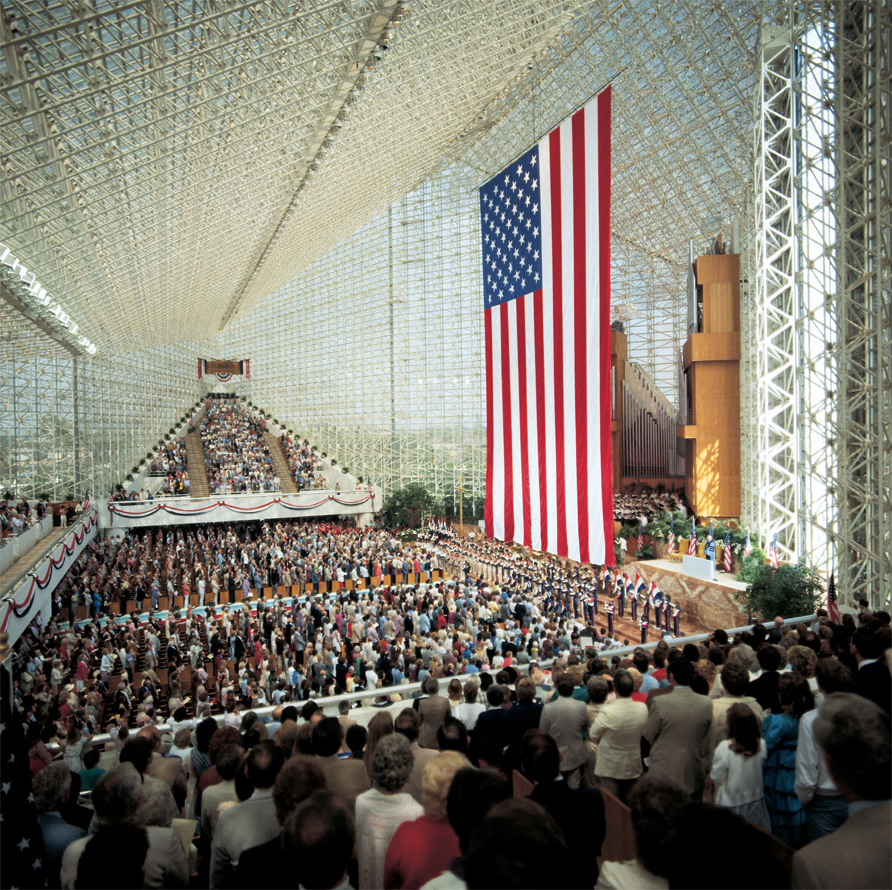
The Crystal Cathedral was a pure show biz, from its movie star guest speakers to its artful use of the power of TV. The largest glass building in the world, The Cathedral was built by the Rev. Robert Schuller.
The building, designed by architect Philip Johnson, was completed in 1981 and seats 2,736 people. Schuller started out in 1955, as pastor of California's first "drive-in" church, in Garden Grove. It was actually situated in an old drive-in movie theatre, Schuller preached from the roof of the concession stand. After significant success on the airwaves, Rev. Schuller opened the Crystal Cathedral in 1980. Each week, the Sunday services at The Crystal Cathedral were broadcast live across the nation as "The Hour of Power," and they often featured Hollywood stars. The Crystal Cathedral’s pipe organ with 16,000 pipes is among the five largest pipe organs in the world, the Hour of Power Choir
with 100-plus voices is also an interesting feature and the electric
fountain/stream that runs down the middle of the central aisle is also
worth mentioning. The mammoth church is indeed impressive, made almost entirely of glass and a spider web framework of white steel, the star-shaped "cathedral"
is something extra ordinary. Over 400 feet long and 200 feet across,
raising some 12 stories above the ground, with an angular, mirror-like
exterior, its transparent, sun-lit interior features a giant television
screen, and an altar of rich marble. The Crystal Cathedral can accommodate about 3,000 worshipers for Sunday services. Giant, sliding glass doors on the side of the church allow even more worshipers to watch the services from their cars in the parking lot. The new glass tower
was added in 1990, is a stunning structure in its own right; at the
tower's base you will find a tiny, dome-shaped chapel housing an
uncommon, cross-shaped crystal. Having over 12,000 glass panes and a
sparkling, modern-day bell tower, The Crystal Cathedral is an Orange County landmark visible for miles around.
The Roman Catholic Diocese of Orange negotiated a pretty sweet deal when it purchased the iconic Crystal Cathedral, the longtime pulpit of the Rev. Robert H. Schuller and backdrop to his popular "Hour of Power" television broadcasts. Not only did Catholics get a national landmark designed by the renowned architect Philip Johnson, but Bishop Tod D. Brown wasn't even the highest bidder: Schuller and the board of the proudly Protestant mega church, opted to take Brown's $57.5 million offer over a $59 million pitch from Chapman University because the bishop would keep the campus as a place of worship.
 |
| The Crystal Cathedral, Garden Grove, Orange County , USA |
 |
| Interior - The Crystal Cathedral, Orange County |
Unique Churches - Santuario della Madonna delle Lacrime"Our Lady of Tears" in Siracusa, Sicily
 |
| Santuario della Madonna delle Lacrime in Siracusa, Sicily |
On 29 August 1953, a small plaster image of the Virgin Mary in the house of Angelo Iannuso and Antonina Giusto suddenly began to shed tears. The following days, on 30 and 31 August and on 1 September, tears were seen again on the Virgin’s face.
The cavernous space was designed to house the image which reportedly bestowed 300+ miraculous cures over a few months after the tears.
The Church
Modeled on the shape of a tear drop, Syracuse's newest landmark building, it opened in 1994 and reaches a height of 102m. The "Our Lady of Tears" sanctuary is one of the most peculiar monuments or churches in all of Sicily. Designed to evoke a gigantic teardrop, the structure was created by two Frenchmen, Michel Arnault and Pierre Parat, in 1994. It houses a statue of the Madonna that supposedly wept for 5 days in 1953. So-called chemical tests showed that the liquid was similar to that of human tears. Pilgrims still flock here.
 |
| Santuario della Madonna delle Lacrime in Siracusa, Sicily |
Famous Churches - La Catedral de San Cristóbal, Old Havana, Cuba
 |
| Plaza de la Catedral de San Cristobal de La Habana Cuba |
 |
| Interior - Plaza de la Catedral de San Cristobal de La Habana Cuba |
Related articles
- Salta Cathedral, Argentina (planbox.wordpress.com)
- Catholic prayer fills the Crystal Cathedral (patheos.com)
Subscribe to:
Posts (Atom)